

From 3-Axis to 5-Axis: Why Shops Are Rethinking What’s Possible with CAMWorks

What Is Machine Aware Programming — and Why Should CNC Programmers Care?
July 14, 2026
Building Your First Technology Database from Scratch in CAMWorks
July 20, 2026

From 3-Axis to 5-Axis: Why Shops Are Rethinking What’s Possible with CAMWorks

For many machine shops, the daily challenge is not just making accurate parts. It is making them faster, with fewer setups, shorter lead times, less rework, and enough flexibility to take on the next job that comes through the door. In a recent CAMWorks webinar, Brad from Marvel Machining shared a real-world look at what happened when his shop moved from traditional 3-axis machining to full 5-axis capability—and why the transition was more practical than he first expected.

Brad’s shop handles mostly aluminum aerospace, automation, and job-shop work. That means low quantities, quick turns, and parts that often require multiple operations. Before adding 5-axis machining, many parts moved from vise to vise, sometimes requiring four, five, six, or even more setups. Each flip introduced more time, more opportunity for error, and more work to achieve the quality his customers expected.

That is where 5-axis machining changes the conversation.

In simple terms, 5-axis machining allows the cutting tool to move across the standard X, Y, and Z axes while the part or table rotates along two additional axes. This can be used as 3+2 positional machining, where the part is indexed into position and machined, or as full simultaneous 5-axis machining, where multiple axes move at once. The result is access to more sides of the part in fewer operations.
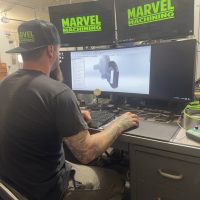
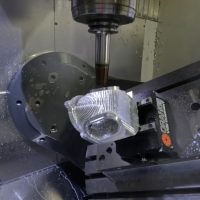
For Brad, the biggest gain was not necessarily faster cycle time at the spindle. It was the reduction in setup time. A hole on the opposite side of a part no longer required flipping the part, picking up a new corner, and spending another 20 minutes preparing the next operation. Features that once required creative fixturing, angled wedges, or multiple blends could now be reached by rotating the part into position.

The benefits quickly became clear: fewer setups, better blending, improved part quality, more efficient programming, and the ability to say yes to jobs that previously would have been difficult or impractical. Brad noted that with 5-axis, chamfering and finishing edges became easier because the machine could rotate the part and approach features at the right angle. In some cases, he could use an end mill instead of adding another chamfer tool.

Of course, the move came with concerns. Brad wondered whether he had enough “true” 5-axis work to justify the machine. He worried about cost, programming complexity, ~toolholder clearance, fixture clearance, and the very real risk of crashes. But his mindset changed once the machine was
on the floor. He realized that not every job needed to be a dramatic simultaneous 5-axis part to benefit from the machine. Even 3+2 machining could turn five operations into two.

The return on investment was especially compelling. Brad purchased a used Haas UMC and said that within the first three months, he had taken in enough work on the machine to cover its full cost. Even more importantly, the machine helped him win repeat work he would not have taken on with only vertical equipment. One complex part became an ongoing monthly order.

Brad’s advice for shops considering the move is direct: start by programming some of your existing 3-axis parts in a 5-axis environment. See what happens when five operations become two, or when a two- or three-operation part becomes one through window machining. Use simulation. Verify clearances. Slow down at first and pay close attention to detail. Once a program is proven, lock the operations so future updates do not unintentionally change the toolpaths.

The webinar is worth watching on demand because it goes beyond theory. Brad shares the concerns, the learning curve, the CAMWorks strategies, and the business impact from a shop owner’s perspective. For any shop wondering whether 5-axis machining is only for complex aerospace showpieces, his experience offers a practical answer: sometimes the biggest opportunity is making everyday work more efficient.

Comments are closed.

Subscribe to Blog

  • This field is for validation purposes and should be left unchanged.

X